
Biodiversity Net Gain, commonly known as BNG, is now an important part of the planning system in England. It requires applicable development projects to leave biodiversity in a measurably better condition than it was before development.
This guide explains how BNG works, the legal requirement, biodiversity units, off-site delivery and the statutory biodiversity metric. It also outlines what BNG means for developers, landowners, local planning authorities and schools.
Biodiversity Net Gain is an approach to development that aims to leave habitats in a better condition than they were beforehand. In England, qualifying developments must deliver an increase of at least 10% in biodiversity value compared with the site’s pre-development baseline.
BNG does not simply mean planting trees or adding a green area at the end of a project. It is a measurable process based primarily on habitats. The condition, size, distinctiveness and location of habitats are assessed before development and compared with the habitats that will remain, be enhanced or be created afterwards.
The objective is to address biodiversity from the early stages of planning. Developers should first seek to avoid harm to valuable habitats and reduce unavoidable impacts. Habitat enhancements or creation can then be used to deliver the required improvement.
Where the full requirement cannot be achieved within the development site, registered off-site biodiversity gains may be used. Government-issued statutory biodiversity credits are available only as a last resort.
You can find concise explanations of related terminology in our Biodiversity Net Gain glossary.
The Environment Act 2021 established the legal framework for mandatory Biodiversity Net Gain in England. This was implemented principally through Schedule 7A of the Town and Country Planning Act 1990.
For most planning applications made on or after 12 February 2024, applicable development must achieve at least a 10% increase in biodiversity value. The requirement was extended to non-major development from 2 April 2024.
The 10% gain is calculated against the pre-development biodiversity value of the on-site habitat. It may be achieved through:

Biodiversity gains delivered within the development site

Registered biodiversity gains delivered at an off-site location

Statutory biodiversity credits purchased from the government as a last resort

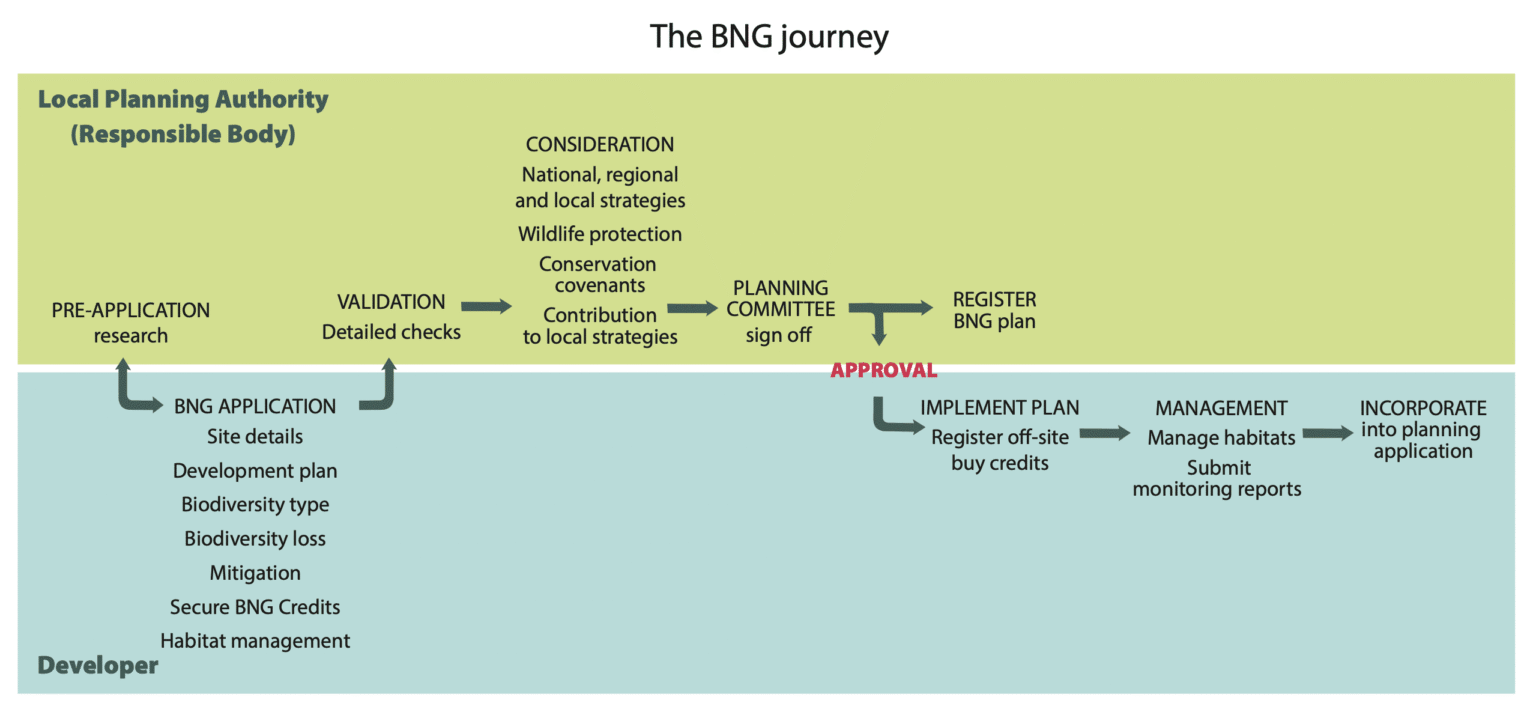
Planning permission for an applicable development is granted subject to a biodiversity gain condition. Following planning permission, the developer must normally submit a Biodiversity Gain Plan to the relevant local planning authority. The plan must be approved before development begins.
Mandatory BNG applies in England and does not automatically extend to developments in Scotland, Wales or Northern Ireland, where different policies and legal frameworks operate.
Not every planning permission is subject to mandatory BNG. Current exemptions include householder applications, permitted development and qualifying developments that meet the de minimis threshold.
For planning applications made on or after 6 August 2026, development on a site no larger than 0.2 hectares may also be exempt, provided it does not affect an on-site priority habitat. A separate exemption may apply to qualifying temporary development permitted for five years or less.
Whether an exemption applies depends on the details and timing of the application. Developers should not assume that a project is exempt purely because it is described as a small development.
Nationally significant infrastructure projects are covered by a separate BNG framework. Mandatory BNG will apply to qualifying development consent order applications made on or after 2 November 2026.
Because requirements and exemptions can change, project-specific advice should be obtained before relying on an exemption.
Biodiversity units provide a standardised way to express the biodiversity value of habitats. They allow the value before development to be compared with the value expected after development and any additional gains secured elsewhere.
Units are not a simple count of plants, animals or acres of land. Their value depends on several habitat characteristics, including habitat type, area, condition and distinctiveness. Other factors, such as how difficult a habitat is to create, how long it will take to reach the intended condition and its location, can also affect the calculation.
Developers should consider BNG according to the applicable biodiversity gain hierarchy. For major development, the general order is to avoid or mitigate harm to relevant habitats and then prioritise the enhancement and creation of habitats on site. Registered off-site gains may address a remaining shortfall, while statutory biodiversity credits should be used only when the requirement cannot be met through on-site or off-site delivery.
The hierarchy was modified for certain non-major developments where the relevant planning application was made on or after 6 August 2026. Under the revised rules, on-site enhancement, on-site habitat creation and registered off-site gains may be treated at the same level of preference for those developments. Statutory credits remain the final option.
An off-site biodiversity gain is habitat enhancement or creation delivered outside the red-line boundary of the development. The gain must be legally secured for at least 30 years and recorded on the Biodiversity Gain Sites Register before it can be allocated to a development.
Developers can purchase off-site units directly from landowners or through habitat bank operators, brokers and trading platforms. The register itself is not a marketplace and does not connect buyers with sellers.
Civity helps connect development requirements with suitable habitat opportunities. Explore our available BNG units for sale or speak to our team about your project’s requirements.
The statutory biodiversity metric is the official calculation method used to measure biodiversity value for mandatory BNG. It was developed by Defra and Natural England and is based on the earlier Biodiversity Metric 4.0.
The metric uses habitat information to calculate three separate types of biodiversity units:
These unit types are not freely interchangeable. A surplus in one category cannot automatically compensate for a shortfall in another.
The metric considers factors including habitat type, size, condition and distinctiveness. For proposed habitats, it also accounts for risks such as the time required to establish the habitat and the difficulty of achieving its target condition. Spatial and strategic factors may affect off-site calculations.
A metric result is an important part of the evidence, but it does not replace ecological judgement. Habitat assessments and condition evaluations should be completed by appropriately competent people. Other ecological and planning duties, including protections for species and irreplaceable habitats, continue to apply separately.
For developers, BNG should be considered during feasibility and site design, not left until planning permission is close to being determined.
The process normally begins with an assessment of the habitats within the development boundary. This establishes the pre-development biodiversity value and identifies habitats that may require protection. Early assessment can help the design team avoid important habitats and understand whether the proposed layout is likely to produce a biodiversity-unit shortfall.
Developers can meet their BNG requirement through three routes:

Create or enhance habitats within the development site.

Use registered off-site gains, either on other land they control or by purchasing biodiversity units.

Purchase statutory biodiversity credits when the requirement cannot be met through the first two routes.
A combination of these routes may be used, subject to the applicable biodiversity gain hierarchy.
The planning application must contain the required biodiversity information. Once permission has been granted, a Biodiversity Gain Plan must normally be submitted to and approved by the local planning authority before work begins.
The plan explains how the development will meet the biodiversity gain objective. It should accurately identify the pre-development and post-development values, show how the hierarchy has been considered and record any off-site allocations or statutory credits being used.
Significant on-site habitat improvements and registered off-site gains must usually be secured and managed for at least 30 years. The precise responsibilities should be established through the relevant plans, agreements and contracts.
Early planning can reduce the risk of redesign, unsuitable unit procurement or delays in discharging the biodiversity gain condition. Read more about Biodiversity Net Gain for developers.
Local planning authorities have a central role in administering mandatory BNG through the planning process.
At application stage, the authority considers the biodiversity information submitted by the applicant and whether the proposed development appears capable of meeting its obligations. Following the grant of planning permission, the authority is responsible for determining the Biodiversity Gain Plan.
The authority should check whether the plan demonstrates the required gain, uses the statutory biodiversity metric correctly and properly records any off-site unit allocations or statutory credits. It must also consider how the applicable biodiversity gain hierarchy has been followed.
BNG responsibilities continue after approval. Local planning authorities may need to monitor delivery, management and maintenance, particularly where significant on-site enhancements or off-site gains have been secured through planning obligations. Where commitments are not met, the authority may consider appropriate planning enforcement action.
Authorities can also help BNG contribute to wider local environmental priorities. Local plans and Local Nature Recovery Strategies may identify locations where habitat creation or enhancement would provide particular strategic value. However, local BNG policy should complement rather than conflict with the statutory framework.
Explore our support and resources for local planning authorities managing Biodiversity Net Gain.
Schools, colleges and other educational institutions are not subject to a separate BNG regime simply because they provide education. However, a qualifying development involving educational land or buildings may be subject to the same planning requirements as another development in England.
This could be relevant to a new school, a campus extension, additional facilities or another project affecting habitats. The development should be assessed to determine whether mandatory BNG applies or whether an exemption is available.
Educational land may also provide opportunities for carefully planned habitat enhancement. Wildflower areas, ponds, native hedgerows and other suitable habitats can support nature recovery while providing practical opportunities for pupils to learn about ecology and environmental stewardship.
Any habitat used to deliver statutory units must be appropriate for the site, legally secured where required and capable of being managed for the necessary period. Safeguarding, access, maintenance and the school’s long-term estate plans must also be considered.
Discover how we support Biodiversity Net Gain projects for schools.
Mandatory BNG under Schedule 7A of the Town and Country Planning Act applies in England. Scotland, Wales and Northern Ireland have their own planning systems and biodiversity policies. Projects outside England should be assessed under the applicable national and local requirements.
No. The 10% requirement applies to developments within the statutory framework, subject to commencement arrangements, transitional provisions and exemptions. Householder development, permitted development and certain low-impact or small-site developments may be exempt. The application date and specific characteristics of the proposal are important.
Planning permissions arising from applications made before the relevant commencement date are generally outside the mandatory BNG framework. Later applications to vary an existing permission can be more complicated, particularly under Section 73. The original application and permission dates should be reviewed before deciding whether BNG applies.
Units can be purchased from a registered gain site, but location matters within the statutory biodiversity metric. Off-site habitat closer to the development or within a strategically significant area may receive a higher score than habitat further away. The units must also provide the appropriate habitat type needed to address the development’s shortfall.
No. BNG units normally represent registered habitat gains supplied through the private off-site market. Statutory biodiversity credits are sold by the government and are intended only as a last resort when the necessary gain cannot be delivered on site or secured through registered off-site gains.
No. BNG is one part of the planning process. A proposal must still satisfy other relevant planning policies and legal requirements. Meeting the numerical BNG target does not override protections for designated sites, protected species, irreplaceable habitats or other material planning considerations.
Whether you are planning a development, exploring the potential of your land, managing BNG applications or considering an educational habitat project, Civity can help you understand the available options.
Our team can support you with biodiversity-unit requirements, off-site habitat opportunities and the wider BNG process.
Contact Civity to discuss your Biodiversity Net Gain requirements.
Information reviewed in August 2026. Biodiversity Net Gain requirements depend on the circumstances of each site and planning application. This guide provides general information and is not a substitute for project-specific ecological, planning, legal or tax advice.
3a Orbis Wharf,
Bridgers Court Road,
SW11 3GW
Manage by Growth4Trades